
Global Perspectives on Energy Transition Highlight System-Wide Planning Needs in Saskatchewan
[Photo Credit: University of Regina]
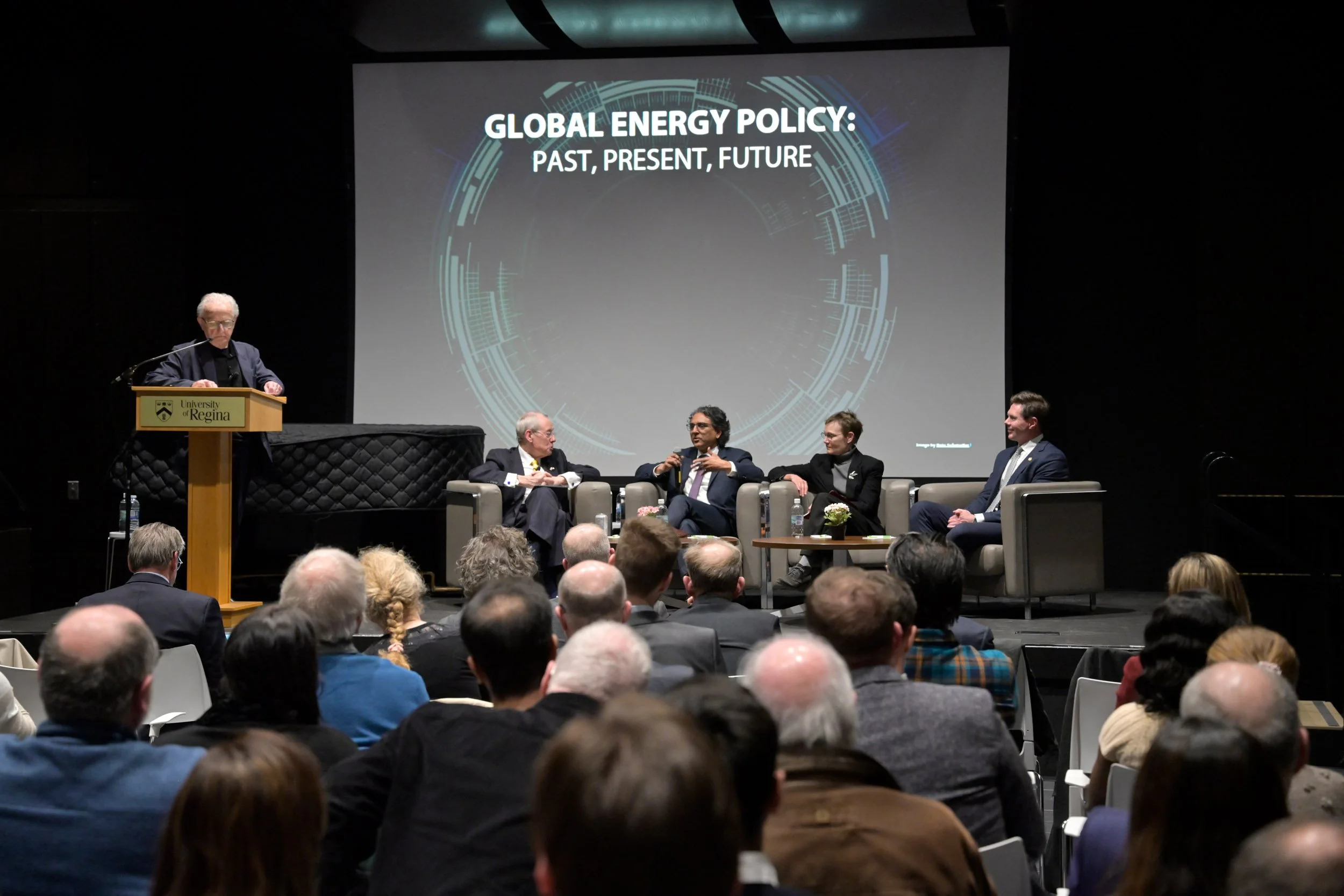
Energy transition is a global priority, with increasing focus on how regions are planning and advancing their own energy futures. A recent public lecture in Regina brought together international and Saskatchewan-based perspectives to explore what this means in practice.
Hosted by the Johnson Shoyama Graduate School of Public Policy, the event opened with greetings from Jeremy Harrison, Saskatchewan’s Minister of Crown Investments Corporation, and was emceed by David Brock, Vice-President, Nuclear Development at SaskPower. The lecture featured Dr. Tim Stone, Chairman of Nuclear Risk Insurers, alongside a panel of Saskatchewan experts representing government, a Crown utility, industry, and academia.
The discussion was moderated by Dale Eisler, Senior Policy Fellow at the Johnson Shoyama Graduate School of Public Policy, with panelists Grant Issac, President and Chief Operating Officer of Cameco; Rupen Pandya, President and CEO of SaskPower; and Margot Hurlbert, Professor and Canada Research Chair in Climate Change, Energy and Sustainability Policy at the University of Regina.
A central theme throughout the lecture was the importance of approaching energy transition as a complete system — rather than a series of individual solutions. Dr. Stone emphasized that while renewables are an important component, long-term planning requires a diversified energy mix — including sources such as nuclear — and the ability to scale proven solutions to ensure an available and reliable energy supply.
For Saskatchewan, this approach builds on progress already underway. The province has taken meaningful steps to integrate renewable energy into its system, while also advancing plans to incorporate nuclear as part of a broader, diversified energy mix. This system-wide approach is essential to ensuring long-term reliability, affordability, and sustainability.
GIEMS was pleased to be part of this discussion and to support ongoing dialogue that connects global perspectives with provincial priorities. Conversations such as this play an important role in informing how energy systems are planned, integrated, and advanced over time.
Key takeaway:
Energy transition must be approached as a complete system — requiring diversified energy sources, including nuclear, and the ability to scale solutions that ensure reliability over time.